
Many years ago, as a wide-eyed and open-hearted student, I spent a year in France. In that long-ago era of cheap Eurail passes and Europe on $10 a Day! guidebooks, I traversed the continent, absorbing the history and culture, the art and architecture, the scenic beauty – all wildly new and wonderful to this naïve middle-class Midwest kid.
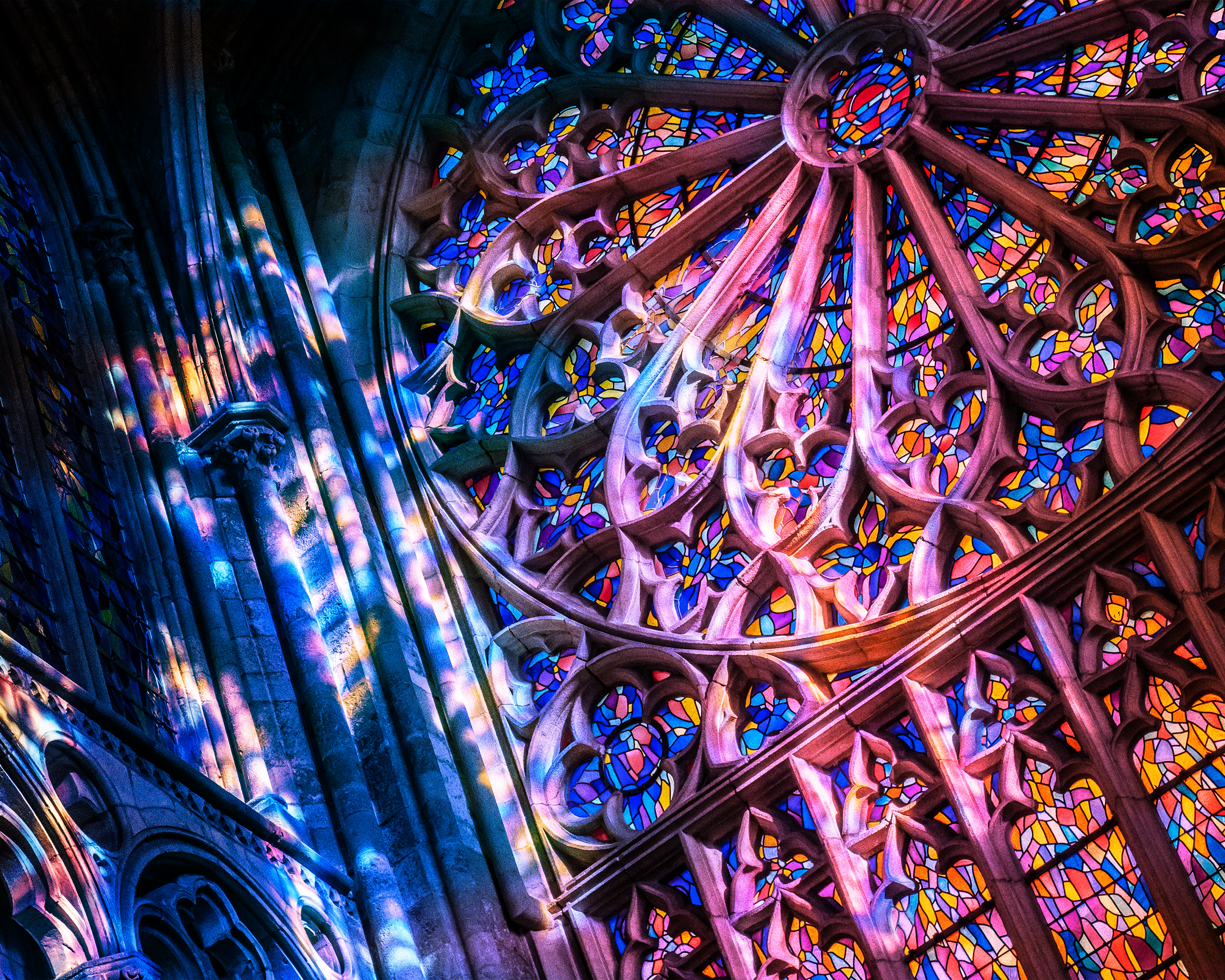
As is true of most American visitors to Europe, I was especially awe-struck by the great gothic cathedrals. I could hardly fathom both the scale and intricacy of design, the interplay of genius, craft, and vision that give birth to these stunning expressions of faith.
I had been studying the history of French art, architecture, and music, including how it all interplayed with the politics and theology of the times. One weekend our class took a field trip to attend high mass at Chartres, considered by many one of the most magnificent of the great cathedrals. There, in the midst of the liturgy, I had a full-bodied experience of all that we had learned in the classroom: In addition to the almost mystical symmetry of columns and arches, I listened to the ethereal polyphonic chants, artistically crafted to echo resonantly off the stone walls made thinner and taller by the invention of flying buttresses. I witnessed the shock of color-drenched light streaming through the stained glass with exquisite timing on the high altar at the point of consecration of the host. It was a sensuous feast and at the same time an experience of otherworldly awe. Holiness rendered in stone, glass, and sound.
Recently I had occasion to travel Europe again – the occasion being my adult daughter living and working in Madrid for a year. Some forty-five years after that first voyage, much of the original startling newness had yielded to a familiarity – yes, some new experiences and sights, but also a more mature appreciation of and openness to uniqueness of cultures.
Of course, our touring took in the requisite cathedrals, chapels, palaces, museums. This visit was largely in Spain and Portugal, which were not part of my youthful travels, and I noted some particularities and differences from the parts of Europe I knew better – extensive decorative uses of gold and intricately designed tiles, the Moorish and Mediterranean influences, and in general a more baroque aesthetic.
I was initially fascinated and taken in by the beauty, but I soon felt something unexpected stirring in me – feelings that increased with each tour of a chapel or cathedral or palace. At some point, as I shared frankly with my family during the trip, I was dismayed, even appalled, at what I was seeing: the almost grotesque excesses of wealth, the indulgent and arrogant totems of power. Unlike the socially innocent twenty-year-old version of me, I couldn’t help but intuit the use of artistic grandeur to uphold a stratified and often oppressive social order.
Most distressing to me was what I saw of the church. That same faith-infused architectural and artistic magnificence that dazzled a younger me now felt like a kind of blasphemy: The heavily gilded and jeweled altars, the ornate liturgical objects, the sumptuous princely garb of the ecclesial superiors, the various portrayals of Christ, the Virgin, and the saints all drenched in regality. At one workshop on medieval metal working, I noticed a replica of a Crusaders sword emblazoned on the grip with the words “Sigilum Militum Christi” – “Seal of the Soldiers of Christ.”
A particularly trenchant and telling moment was standing in the plaza of the Royal Palace in Madrid. The stately palace stood on one side, while immediately across the plaza was the massive Almudena Cathedral – complementary monuments to imperial dominion.
As I continued to struggle with these intense feelings, I realized the catalyst: My deepening distress at the intensification of Christian nationalism back in my home country. It might seem a stretch, from a fifteenth-century lushly gilded altar in Spain to MAGA Christianity in 2026. But I sensed the same taproot: the lethal fusion of religion and power.
In the four decades separating my two Europeans sojourns, my own spiritual journey had led me to a radical encounter with the Christ of the Gospels. Far from the kingly Savior of stained-glass windows exuding might and demanding worship, the Jesus I came to know was the one who proclaimed the Sermon on the Mount, who communed with the outcasts and lowly, who announced the reign of God as a startling antithesis to worldly power. This Jesus eschewed force and embraced suffering servanthood. This Jesus broke down walls of division and called for embracing enemies. This Jesus denounced false and destructive religious authorities and railed against wielding the sacred traditions to uphold hierarchies and oppress those on the bottom.
All of which demanded from me a fierce reckoning with the long litany of abuses in church history. European Christendom was born in Constantine’s fifth-century co-opting of the faith, putting it at the service of the empire. The institutional church soon aped the hierarchies, patriarchy, wealth, and addiction to power of their political cousins. The early followers of Jesus refused to kill or serve earthly usurpers to God’s authority – but within a few short centuries, they were pledging allegiance to kings and emperors and slaughtering “infidels” to God’s glory. The successors to the original apostles (who almost all gave their lives as a witness to the ways of Jesus) soon oversaw the Inquisition, the Crusades, the torturing and burning of “witches” and “heretics,” the conquest and decimation of indigenous peoples – all in the name of Christ, all expressions of piety and devotion. The papal decrees of the Doctrine of Discovery gave a theological green flag to the ruthless and often violent expansion of European imperialism
But this wasn’t just ancient history – the demon of worldly power has continued to infect the institutional church over the centuries, invariably with destructive consequences. What we are witnessing in the United States today is simply another manifestation: Christian faith wedded to political power, patriotism, and militant nationalism. The violent uprising at the U.S. Capitol on January 6, 2020, featured numerous tokens of Christian faith – crosses, Bibles, pictures of a white Jesus donning a red MAGA hat.
Some form of Christian nationalism has been a constant in U.S. history, usually blended with White supremacy (the Ku Klux Klan promoted themselves as a Christian movement). That same Doctrine of Discovery became a taproot of the ideology of Manifest Destiny, asserting the divinely ordained nature of the United States – and undergirding a near genocide of original inhabitants of the land.
A new chapter in this story was ushered in when, in the 1970s, Republican strategists stoked the racist resentments of southern Whites and molded from it the Moral Majority – a fiercely conservative movement that mobilized previously apolitical evangelicals, equating Christian faithfulness with Republican policies. Over the next few decades the Religious Right became a dominant force in American politics
Just as it seemed the political clout of evangelical Christianity was ebbing in the 2010s, it got a startling jolt of energy from the emergence of Donald Trump. While the early iteration of political Christianity was wrapped in traditional moralism (recall the Clinton sex scandal), the Trumpian version took a wild and, to many, utterly incomprehensible turn: MAGA Christians, in their zeal for a full-blown theocracy in the United States, embraced a crude, scandalous, and morally reprobate bully as the anointed of God. Prosperity gospel, conspiracy theories, and barely concealed racism and xenophobia took center stage. Formerly fringe religious figures such as Doug Wilson, Lance Wallnau, and Dutch Sheets began having major influence on national policies. While the early Religious Right minimized the actual teachings of Jesus, MAGA Christianity has embraced a worldview and theological spirit that trashes Jesus’ teachings in a maelstrom of hypocrisy.
A contemporary American version of Christendom has emerged, with evangelical pastors blessing the intensifying militancy and worship of mammon. A re-invigorated “biblically based” patriarchy is once again putting women in their (inferior) place, with hints of a “Handmaid’s Tale” dystopia. While we are not burning infidels, many ministers are gleefully burning Qurans, while millions of Christians are supporting aggressive anti-immigrant policies, wanting those dangerous “others” to be cast out of our racially and religiously pure country. Today’s soldiers of Christ – in some cases actual armed militias – promote a muscular, pro-military and pro-gun machoism and applaud the Trump administration’s aggressive tactics in U.S. cities and abroad.
The modern equivalent of the great gothic cathedrals are megachurches, with their imposing stadium-like architecture and state-of-the-art audio-visual technology. In place of the ermine-clad cardinals flouting their ecclesial authority are the well-groomed preachers and pastors with their private jets, mansions, and media empires – not to mention an open door to the White House (or should I say, the Trump royal court).
In his book The Kingdom, the Power, and the Glory, Tim Alberta, himself an evangelical Christian, argues that the core of contemporary Christian nationalism is a lust for power. Evoking the Hebrew prophets, he observes that “America has become an idol” to MAGA Christians. To the contrary, he insists, “Christianity is inherently countercultural. That’s how it thrives. When it tries to become a dominant culture, it becomes corrupted.” A pretty fair diagnosis of both European Christendom and contemporary U.S. evangelical Christianity. And in both cases, the actual teachings of Jesus disappear, while that lust for power brings victims in its wake.
It is perhaps some consolation that Jesus himself gave us fair warning about all of this: “Take heed that no one deceives you. For many will come in my name, claiming, ‘I am the Messiah,’ and will deceive many” (Matthew 24:4-5). Many, indeed.
But not all: Hope shines through the historical storm clouds. The corrupted version of the Western church could never fully suppress the numerous movements of reform and radicalism throughout the centuries. St. Francis and his followers sought to rebuild the church through an embrace of Lady Poverty and a spirit of boundless compassion, mercy, and simplicity. The Beguines gave an opportunity for the flourishing of women’s gifts outside of patriarchal priestly control. Mystics and pietists saw through the trappings of worldly illusions and embraced the spiritual heart of the faith and the centrality of a moral and loving life over creeds and rituals. Even as much of the early Protestant (e.g. protesting) revolution succumbed to the same worldly practices of power as the Roman church, the Anabaptists understood the Gospel as a radical alternative to worldly power and refocused on the centrality of the way of Jesus. Later, the Confessing Church in Nazi Germany, the abolitionists, and faith-based civil rights activists grasped the vision of the God of liberation, as did Christians on the margins in the global south struggling against colonial domination (of which the church was an arch pillar). Most of these groups drew the ire of the authorities they opposed – not unlike the Lord himself.
Where is such hope in our current moment?
A daunting challenge, to be sure, but for those seeking to follow the Jesus of the Gospel, it begins with an unflinching and clear-eyed diagnosis. Just as Jesus’ ministry could not begin until he had wrestled with the idols of political, economic, and religious power, we must engage in some desert wrestling of our own: Our task begins by naming our addiction to power, our allegiance to worldly security, our trust in empty idols for refuge from our fears.
This includes umasking the brazen lies at the heart of the Trumpian theology of MAGA Christianity – but also acknowledging the fear that leads so many people to embrace it. These are scary times, as systems we have come to depend on are failing, social realities we have grown comfortable with are fracturing, prevailing notions of value and meaning are showing their inherent hollowness. In the midst of such collapse, perhaps we might rediscover biblical faith anew. We might hear through the din that the prophets continue to tell us that our hope and security is in the Lord, not in the king or president or army. Our hearts might open to Jesus’ radical and world-shaking notion of God’s unconditional love for us – and for everyone else – and that in such love is the truest form of power.
Not that it won’t entail risks and struggle. We may be called to what grassroots theologian, pastor, and activist Rev. Lynice Pinkard calls “dissident discipleship” — “a high-cost discipleship that calls us to stand against everything that is oppressing people, every form of suffering.” We may need, in some fashion, to go “underground,” like the Confessing Church under Nazi Germany, to rebuild our core theology around the Semon on the Mount.
The mustard seeds of a new American Christian radicalism are there: Faith leaders are increasingly speaking out against the brutalities of ICE and the dehumanization of our immigrant neighbors. Followers of Jesus are engaging in risk-taking public witness in ever greater numbers. May such seeds find more rich and nurturing soil.
I long for the old innocence that would allow me to appreciate the artistic achievements I was beholding in the Gothic cathedrals. I wished for that unadulterated awe in the face of such beauty, even in the intensity of faith that birthed these monuments to God. But I cannot fully separate the aspiration to express divine glory from the imperial expression of human power and glory. Caught in the grip of this suffocating neo-Christendom in contemporary America, perhaps this is a time to accept that once again, a dominant model of church and even many of our fundamental understandings of faith must die – and in fact are dying. And as they die, maybe our eyes might be open to a beauty and awe at faith expressed in radical servanthood, boundless mercy, and loving resistance to all that destroys and dehumanizes any persons endowed with the very spark of God. True faith is, after all, pretty good at resurrection.

Will O’Brien is founder and coordinator of The Alternative Seminary, a grassroots program of biblical and theological study. For over forty years he has been involved in advocacy on issues of homelessness and poverty. He is part of an intentional faith community, Vine and Fig Tree, in Philadelphia.

Unbound Social