
The parable of the Good Samaritan is peculiar because it follows after a Samaritan village rebuffs Jesus. To appreciate the parable in Luke 10, one should read from near the end of Luke 9, where the Samaritans are first mentioned. When Jesus sends messengers ahead to a Samaritan village to prepare his arrival, the people did not receive him “because his face was set toward Jerusalem” (9:51-55). The Gospel frames much of Jesus’ ministry around his journey to Jerusalem.
The Samaritans were descendants of the people of the kingdom of Israel, which was conquered by the Neo-Assyrian Empire centuries prior. The Samaritan priesthood held Mount Gerizim as the true site of worship, while the Judahites of the former kingdom of Judah and the Judean Jews under the Roman occupation insisted that Jerusalem was the only legitimate site. So, when the Samaritan people learn Jesus was headed toward Jerusalem, they seem to assume that he, like the Jews of Judea, is making a political and theological stance that legitimizes the Jerusalem temple.
However, he is not Judean. He is Galilean. Judeans viewed Galilean Jews with low regard, as backwoods, uneducated, and culturally and economically inferior. Although Galilean Jews made pilgrimages to the Temple in Jerusalem, they had a more complicated relationship with it than their Judean cousins, who had easier geographical access to it. Jesus himself, and his Galilean disciples, are the othered Jews who are neither Judean nor Samaritan. They are the queer, the marginalized, and the other. But they–the Galileans, Judeans, and Samaritans–all live under the occupation of the Roman Empire. And Jesus’ focal point, however, is not whether Mount Gerizim or the Temple Mount in Jerusalem is the rightful place of worship, but how we show hospitality.
Jesus then appoints 70 disciples (some manuscripts say 72) in pairs to every place Jesus intends to go, instructing them to carry basically nothing and greet no one on the road. When a home or town welcomes them, they are to bless them with peace, eat and drink whatever they are given, heal the sick, and share the gospel of the nearness of God’s kingdom. But if a place rejects them, they are to publicly shake off the dust of their sandals and warn them of the nearness of God’s kingdom.
Jesus’ instructions to his disciples to accept whatever meal they are given in these homes and villages dismantles a cultural barrier between Samaritans and Jews. Although Samaritans and Jews followed the Torah’s dietary laws, they prepared food differently, meaning a Samaritan meal might not have been considered acceptable for a Jewish person. Even knowing of the possible rejection, Jesus is intentional in his effort to connect with Samaritans.
Jesus then pronounces woes upon cities. But instead of pronouncing them against the Samaritan town that rejected him, he pronounces them to the Galilean towns of Chorazin, Bethsaida, and Capernaum, saying that even the Gentile cities of Tyre and Sidon would fare better on judgment day. Perhaps he does so because rejection hurts more when it comes from our own than from the ones we expect. Jesus tells his disciples that whoever accepts them accepts him, and whoever rejects Jesus rejects the one who sent him.
The 70 return joyfully, for even other spirits submit to them in Jesus’ name. Jesus says he watched Satan fall from heaven like lightning. He affirms their authority but tells them to rejoice that their names are inscribed in heaven. He rejoices in the spirit, thanking God for revealing divine truths to “infants” rather than to the smart and wise, and tells them they are blessed to perceive what even rulers and prophets have longed for but never saw.
When a law expert inquires Jesus about eternal life, Jesus points to love: love God and love the neighbor as oneself. The law expert asks, “Who is my neighbor?” Jesus responds with a parable that uplifts a Samaritan as the good neighbor–even after Jesus had been rejected in a Samaritan town. In the parable, a traveler is targeted and severely attacked by robbers and is left nearly dead. A priest coming from Jerusalem sees him, but ignores him. As does a Levite, who serves the Jerusalem Temple. But a Samaritan comes along. Moved by compassion, he tends to the traveler’s wounds with his oil and wine. He loads the traveler onto his animal, takes him to the inn, cares for him there, and pays the innkeeper for continued care, promising to repay any extra expenses on his return. Jesus asks who was a neighbor to the traveler. The law expert answers, “The one who showed him mercy.” Jesus responds, “Go and do likewise.”
The chapter ends at the village of Martha and Mary, where Jesus affirms the importance of women participating in the movement as disciples alongside men. One wonders if Jesus repeats the parable at Martha’s village, where Martha is fully occupied with the work of hospitality all by herself. She is doing nothing wrong, of course, but is being a splendid host. And after all, Jesus’ ministry relied on the graciousness of people’s hospitality. But the point of the story of the Good Samaritan is not just hospitality, but also dissolving boundaries, seeing the Imago Dei in those who are othered within our communities, and showing up in solidarity.
As a queer Korean-American immigrant living in the United States–particularly in a region that is at odds with my political identity as a person and whose home country is occupied by the U.S. military–I often look for my neighbors. Today, there are ICE agents who look like me and agents who are a part of racially subordinated groups betraying and selling out their own communities for the promise of some thirty pieces of silver.
But sometimes, I am surprised to see who is using their time and resources, and even risking themselves to be in solidarity with their immigrant neighbors. Sometimes, the good neighbor is a straight, white man preacher who is working alongside queer people for the first time. And maybe to his surprise, sometimes, the good neighbor is a queer Korean-American person holding gendered, racialized, and religious scars. These instances remind me of the 2014 movie Pride, based on a true story from 1984, about lesbian and gay activists in Britain who allied themselves with striking Welsh miners, forming personal connections with them and their families in a small mining village in Wales.
In these last few years, when queer people have expressed solidarity with Palestinians living through occupation and genocide, we are told to go to Gaza to see what happens, insinuating that the Palestinian people would oppress and commit violence against people of the LGBTQ+ community. This attempt to silence voices dissenting against the violent settler state of Israel is, of course, not coming out of any concern for queer people, but is an othering, orientalist tactic in hopes of drawing out an anti-Arab, anti-semitic, and anti-Muslim fear response that non-Arab queer folks may have internalized through years of white Christian nationalistic propaganda.
Recently, I was moved by a drawing by Ahmed Al-Sabti, a lawyer and artist in Gaza. Amidst the rubble of his home, through a time of genocide and a settler-state-imposed famine, Ahmed drew Priscilla, host of Drag Race Italia who has been outspoken about the Palestinian genocide, holding a baby bundled in a kuffiyeh. In the picture, Priscilla is smiling, exuding warmth, love, and peace, wearing a sheer head veil draping over and down past her big, curly hair. The two figures are portrayed as Madonna and child, as Drag Mother and Palestinian child. I wonder–is Priscilla holding a child who is alive? Or does the baby represent the babies who have been killed Gaza, the West Bank, and southern Lebanon? Either way or both, Ahmed’s art defies the western imperial attempts to cast Palestinians as enemies (including queer people of Gaza) as enemies to our community. When imperial powers attempt to erase the map of Palestine, our solidarity with one another etches a new, spiritual map forged after the blueprint of God’s Kindom.
In the Kindom/Neighborhood of God, chosen families expand. We make new neighbors, and God’s Holy Neighborhood grows and grows queerer as we dissolve boundaries and build loving connections. For Jesus, whether one worshipped at Mount Gerizim or at the Jerusalem Temple, that did not matter so much as how we devote our lives to building upon the Kin-dom/Neighborhood of God through the relationships we create with one another.
Referenced: https://www.instagram.com/p/DYctrE0CEtF/
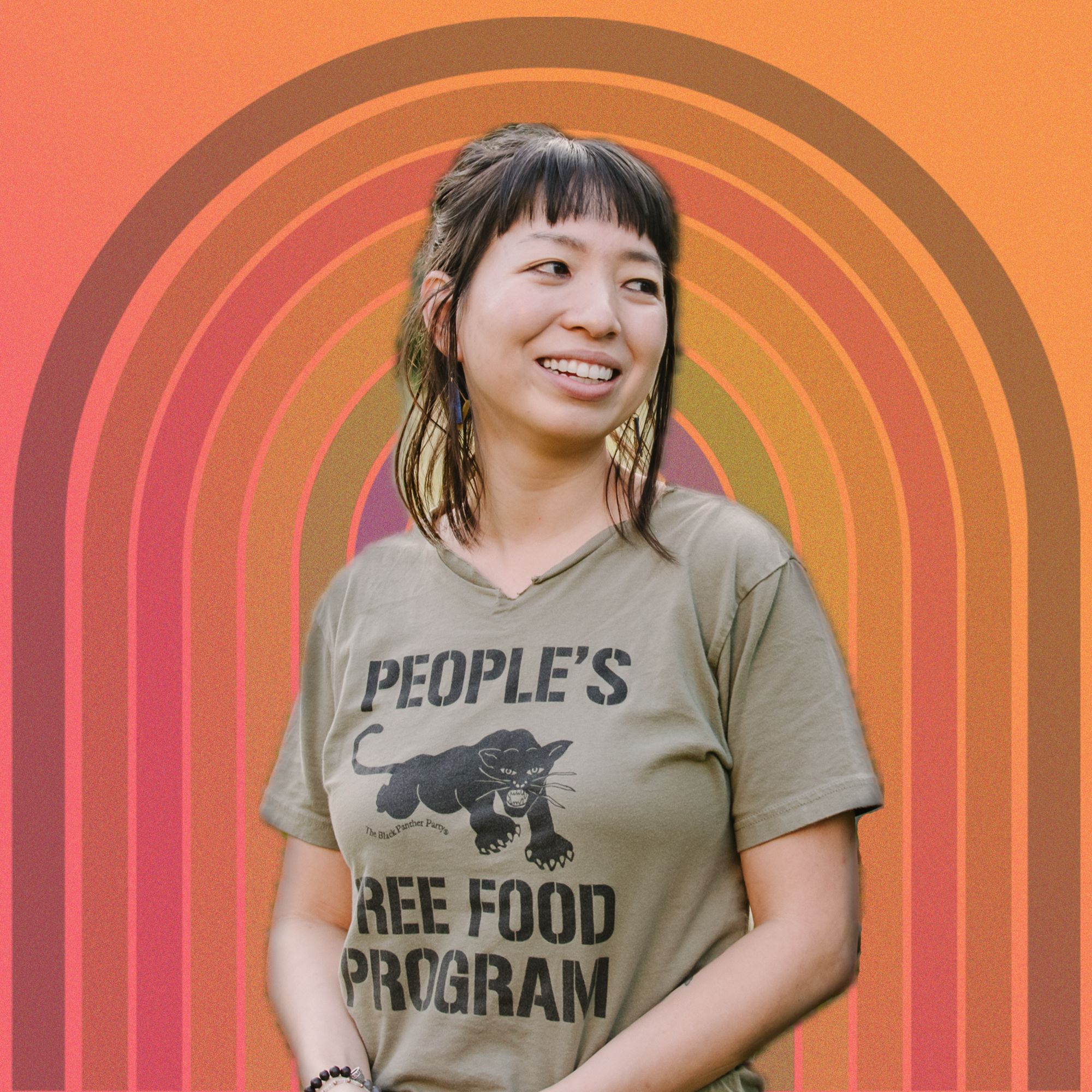
Sulkiro Song 송슬기로 (she/they) is a queer, 1.5-generation Korean-American who currently serves as a pastor at HA:N United Methodist Church, a queer-celebrating, multi-ethnic, virtual church community founded by lay Korean-Americans. Before becoming a pastor, Sulkiro graduated from Union Theological Seminary in NYC with a degree in biblical studies. They had entered seminary “strictly for academic reasons,” never having imagined that they would find communities of the queer and ally faithful, who are anti-imperial and liberation-minded.




Unbound Social