
The late Pope Francis was not a religious model of mine but a figure whose work in the Catholic Church I must commend. As all broken clocks must be right twice a day, he once attested to the idea that every religion is a way to arrive at God.
We can say that we are all having the same conversation but in a different language. The sense that only your doctrine is the right one is hard to shake because the Christianity I was brought up in holds this as a tenant.
Many responded to Pope Francis’ assertion as blasphemous, but I have always found it hard to hold a sense of supremacy in what can denounce other people’s faith.
My grandmother, who I make a concerted effort to speak to at least once a week, is in her 70s. She goes to the market regularly, haggling furiously to get the best price and produce to stand over in the kitchen for many hours. She is sort of a diva in that her head scarf matches her purse which matches her shoes almost every day. She asks kindly that I help her change her nail polish whenever she comes over to our house, and wears blue eyeliner on her waterline every day. She is a running shard of light through my heart.
My mother’s mother is a Muslim.
Her ways are an iteration of this idea of the divine in my life. I watch her pray, hands familiarly passing over beads. She prays for me every time we call and when she does, she speaks in the comfortable words of biblical scripture that her daughter favours, calling on Jesus, speaking in my tongue as a blessing to me and my mother.
I often try to speak her language of the divine back to her. Greeting her on holidays in Arabic over WhatsApp, holding onto an extra scarf in my bedroom to keep the space for her prayers. I hold the words to the tip of my tongue, and find that the divine is listening here too.
Religion stands as a fundamental current of public life but also for many, our personhood, and we are often made to be fluent in it unknowingly. Nigeria’s religious makeup is put simply, a 50/50 Christian and Muslim split. Traditional religions, as they are called, seem to have more of a firm presence in the diaspora. I have met more Yoruba priests in New York than in Nigeria, and maybe this is by virtue of my upbringing. However, aside from the intimacy of being a witness to my grandmother’s relationship with the divine – I have spent time unwinding the languages of the divine that have come from a departure from our indigenous practices.
Candomblé is a syncretic Brazilian religion that combines elements of Catholicism and Yoruba spirituality, created as both a form of resistance and adaptation to Christian colonialism. Studying the way these are interwoven, though an inheritance of violence, I often think how beautiful it is to be able to weave these two doctrines together – to be bilingual in divinity, to speak to God in two tongues.
This could be described as religious pluralism, and you could argue that a pluralist is what I am. My tongue finds the words in the Bible a soothing balm, particularly when attached to whispered prayers from my mother on hard days. Yoruba gospel songs from my childhood, and the chorused phrases of hymns from days clustered in the school hall during cold Sunday evening chapel services fill my mouth absentmindedly. Christianity is my spiritual home, and it seems to fit me fine, though I understand why others feel squashed by it.
In deconstructing the divine, ceaselessly picking it apart and grasping at it, you have to untangle the violence it has wrought – you have to look what has harmed us squarely in the eye.
I think there are ways we can dismantle the harm, in the same way we can extract tools from systems that govern the world. The issue with this process of deconstruction is the required willingness to subject yourself to discomfort and challenge.
Last year, I stumbled across a book on Yoruba spirituality during a browse of a hole-in-the-wall bookstore somewhere in Brooklyn and I have yet to read it. In the period where I was most often reckoning with my distaste for colonialism, capitalism and the other systems that unmake our world, I did not prioritise decolonizing my religious belief system because it was too intimidating. I was raised in a culture where questioning God was not part of appreciating the divine, but blasphemy.
I have begun to do this through spaces that have made talking about God full of questions. Places that allow me to live in the undefined perception of the divine. I talk to God in conversation, like I would a friend. I see her in a careful joke the world plays with light or a delayed train car. I may not have all the words yet but this itself is a language.
Two years ago, I had my cards read for the first time by a former ‘law enforcement’ officer named Iya Patsy or Miss Pattie, a Yoruba religion practitioner, at a hole in the wall bar in Bushwick named Pink Metal after I biked there to pick up some items I had left behind the night before. She sat and greeted my divinity and I, hers. We spoke of her babalawo, or spiritual advisor, and she told me that I might have a calling.
I take the languages of others’ divinity seriously. I want to understand them because it is important to talk about what could exist outside of us. It’s even more important to listen to how other people think of it, to try to speak their language.
I don’t favour evangelism at all, from many experiences, having preached at and been preached to by people of various faiths but once in a while, there are good moments.
On one of these days, I was wearing my pink bunny ear hat. My friend Molly made it for me for my 20th birthday, and it’s one of my favourites when it’s cold. It’s bright, and I wanted one because it reminds me of Louise Belcher, from Bob’s Burgers. On meeting me, you wouldn’t think it but pink is my favourite colour.
I am reading for a class, scribbling notes on the 4 on my way to Union Square. Tuesday night, 6pm, First Presbyterian. It’s bible study.
I spent almost every week of college in this space, unpacking our shared language of the divine with people who like to ask questions.
A lady, her name was Deborah, like in the bible, sitting next to me wearing a mask asks me what I’m reading, whether I made my hat and I explain that I make other things but not this one, and we talk – about God, what it’s like to be in college, about art and what she likes to make. She wishes me luck, points out her son at the end of our row who gives a wave, and two stops before I’m due to get off, she says she wants to give me something.
Reaching into her wallet, she goes first for a $20 bill and then instead pulls out $100, folds it into my hand. The train comes to a hush, time is suspended and I notice the awed faces startled at our interaction.
The moments that come from being quietly listened to when wrestling with how to talk to what is known to me as God, and trying to hear the divine in all its languages, being in my body and confiding in the practices that others have the openness to share still shake me, but the elevation of spirit I feel does not surprise me.
We are all talking, whittling away at ourselves, desperate to make sense of living, and hungry for a way to pull out the incommunicable and show it to someone. It is why we talk to the world and the divine, and it remains hard to understand. This effort that requires us to sit with another’s words, absorb their weight as they leave the heart then mouth must always be in conversation.
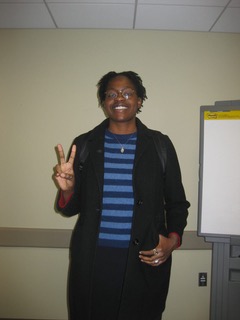
Eyitoluwani is a writer and aspiring urban planner based in Brooklyn, New York. Their writing is informed by a commitment to untangling how we arrived in the world as it is, and how to make space for a new one. They prioritize talking about the spiritual experience of queerness, decolonizing their lived experiences around religion, and taking ownership of their self-expression.
Through the lens of placemaking, they explore politics, cinema and television, urban space and housing policy – discussing the influences of cultural, political and physical space in creating our sense of home.

Unbound Social