

Matthew Vines came out as gay in 2010. In 2014, Convergent Books published his book, God and the Gay Christian: The Biblical Case in Support of Same-Sex Relationships. In four years, Vines rose from being a closeted teen in Wichita, Kansas, to a national spokesman for gay Evangelicals.
Soon after, in 2015, Obergefell v. Hodges legalized gay marriage, allowing churches who wished to perform gay marriages do so with the backing of the state. From the start, Vines organized his ministry around proving the acceptability of gay marriage to evangelical Christians on evangelical Christian grounds. Vines’s participation in the struggle for marriage equality was young when the movement achieved its massive success, which had nothing to do with him.
The Reformation Project, which Vines started in 2013, is still laboring to build support for three modest affirmations: that “being gay, bisexual, or transgender is not a sin”; that Christians should bless “monogamous, covenantal same-sex marriages”; and that “gay, bisexual, and transgender Christians should be allowed to serve and use their spiritual gifts on the same terms as everyone else.” As Vines affirmed in a recent op-ed, his vision is “far from radical.” He is a conservative debating conservatives, and he won’t stop until he can walk away with their affirmation.
Vines has grown to love his struggle. Accordingly, in recent years, he has taken a new target: any LGBTQ people who have needs and desires besides gay marriage. That includes Christians who refuse the culturally contingent genders and relationships to which the church has chained God and instead discern new life in Christ in forms of community and relationships prepared for us by older, fearless generations of gays, lesbians, trans, and queer people who have fought hard and suffered dearly. LGBTQ Christians are speaking and loving with new tongues, but Vines sees Babel where the Holy Spirit has brought a Pentecost. This lisping glossolalia threatens the careful treaty Vines is negotiating with the Christians from whom he wants approval. Because he fears that when respectable, straight Christians look at him, they see past his blazer and see the rest of us.
Vines’s op-ed “I’m Gay, Not Queer. It Matters.” was published last week by the New York Times. In it, he says nothing about the whirlwind of violence, hatred, and legal assaults that Republicans and self-styled “moderate” Democrats have unleashed on trans people in this country. (Although he assures us, “I have friends who are transgender.”) Rather, when Vines observes this country’s landscape of fascism, state disappearances, genocide, and the denial of life-saving healthcare to women and trans people, what disturbs him most is a potentiality: the potential that a future lawsuit might undo Obergefell v. Hodges, and with it, his marriage.
I do not want Vines to lose his marriage, which I pray is a sanctifying relationship for him. Some of my closest friends are gay married, and courts breaking their legal bond would be devastating. A court cannot break their sacramental bond.
However, Vines places blame for this hypothetical lawsuit in a strange—yes, queer—place: not an historically corrupt Supreme Court, white Christian nationalism, or the homophobes themselves who no doubt are trying many such lawsuits. No, Vines blames all LGBTQ people who are not organizing our lives under the ideological, theological, political, and aesthetic regime that he continues to choose for himself: conservative white American evangelicalism. “Queer” can be used as an umbrella term, yes, but as an early queer theorist said, “queer” means something differently when it is used in the first person versus when it is used by a bully or a homophobe. Vines returns the word to its pejorative use.
There are many things to pick at in Vines’s op-ed, given that he still reads texts and people like a fundamentalist. He either can’t see or tolerate complexity, so he demands simplicity from texts and people who have no interest in being simple. One casual but terrible error is that, in the footsteps of Andrew Sullivan, he claims the epidemic of HIV/AIDS is over.
Rather than considering the piece point by point, I have two larger questions: Why was Matthew Vines ever given a platform in the first place? And why was God and the Gay Christian such an important—and I have to assume—actually life-saving book for many evangelicals, when its arguments were, even then, quite old? The two questions have the same answer.
I remember when the God and the Gay Christian came out. Even then, I found it gross how Vines uses his father in the book as a rhetorical device, a kind of dummy to prove wrong in each chapter, thereby demonstrating his own superior reasoning. Still, I was heartened when it was published. I had been in my own harrowing process of reckoning with my desires in Christian community and with family, and I was blogging my way through it. I remember feeling like every evangelical pastor and scholar who changed their mind about gay marriage made my life a little more possible. I didn’t know our history, either. I didn’t know older LGBTQ people.
Vine’s swift ascent to a papier-mâché position of authority in the early 2010s was enabled by a few factors. Social media had hit its stride, allowing a speech Vines gave in 2012 at a church in Wichita to go viral. The fight for gay marriage in the United States had been building momentum for a couple decades and the Obama presidency had liberals drunk on progress. There was an active blogosophere forming where LGBTQ Christians could workshop their ideas, bringing together a cohort of gay, lesbian, and bisexual Christians—like Wesley Hill, Justin Lee, Ron Belgau, Chris Damian, Melinda Selmys, and Eve Tushnet, along with interested straight people like Preston Sprinkle and Mark Yarhouse. And Christian publishers capitalized on the moment, offering books for and against gay marriage that they marketed as brave and groundbreaking. Book releases were opportunities for speaking tours, and at my own Christian college, Seattle Pacific University, I formed and chaired the Presidential Action Cabinet for the Discussion of Homosexuality that procured funds to bring Justin Lee and Ron Belgau to campus.
Into this scene comes Vines, a young white gay cisgender man who wears blazers and speaks with determination, looking the part of a young Republican, not the kind of scary, indecent, or difficult-to-read queer person he blames for potentially ruining his marriage.
Those more immediate factors emerged from two intertwined histories:
- A tradition of pro-gay biblical scholarship, theology, and activism going back at least to the 1950s.
This history has been told in Mark D. Jordan’s Recruiting Young Love: How Christians Talk about Homosexuality, Heather White’s Reforming Sodom: Protestants and the Rise of Gay Rights, and, most recently and apropos to this discussion, William Stell’s Born Again Queer: A History of Evangelical Gay Activism and the Making of Antigay Christianity. - The ongoing ways Evangelical Christians conceal LGBTQ history from the cultural fish bowls in which they raise their young, cutting off queer Evangelicals from potential avenues of support and community.
As I have argued in Coarse Work: Essays in Theology and Gay Life, a lack of access to our history causes every subsequent generation of LGBTQ Christians to feel as if we are the first to exist. The same arguments, like those rehearsed in God and the Gay Christian, are made again and again and are welcomed each time as new revelations.
Vines’s life and perspective are clearly a product of these intertwined histories. When he came out, he didn’t know where to turn. He didn’t know what it meant to be gay and Christian. So, he dropped out from his undergraduate studies at Harvard to “devote[] years of intensive research into what the Bible says about homosexuality,” as the book’s dust jacket reads. During that time, he read some of the more publicly available pro-gay works in biblical studies. The collection of texts he assembles are appropriate for a college research paper, but the book he made with them remains deeply unaware of earlier pro-gay Evangelical institutions and movements like Rev. Troy Perry’s Metropolitan Community Church and Dr. Ralph Blair’s Evangelicals Concerned (both of which are discussed in depth by Stell in Born Again Queer). The substitution of memoir for history in God and the Gay Christian makes it feel like gay Christianity is only beginning in the 2010s and that the “gay Christian” of the book’s title is Matthew Vines himself.
Why did Convergent Books give a publishing contract to someone who offered himself as an expert on antihomophobic biblical interpretation—an academic discipline—who did not appear to know the history of the field, who had the opportunity to hone his research skills and critical thinking apparatus at Harvard University but chose not to, and who had, it appears, not lived in community with gay people for any significant amount of time? Because it would sell. Why would it sell? Because evangelicals have at every turn disowned LGBTQ evangelicals, keeping them out of the institutions through which we would be able to teach our history. This creates a perennial need for a Matthew Vines. He was not the first and he will likely not be the last.
When the national government and state governments are stripping away protections for free speech and prohibiting the teaching of Black, queer, and indigenous histories, while targeting trans people in lethal ways, the choice to seek a national platform to heap blame onto a population already under attack by fascists does their work for them. Vines’s idea of a “dignified future” is one in which he and his husband are safe while those of us who are called to loves beyond celibacy or marriage deserve whatever is coming for us. He risks confusing God for a white picket fence. His future, frankly, sounds lonely.
Darlings, let us choose to learn the dignity of love, risk, study, pleasure, difference, and accountability to one another. Let us learn and preserve our history, take care of our elders, and educate the youth in our ways. Let us build and protect the institutions we need to do these things. And let us consecrate them to God.
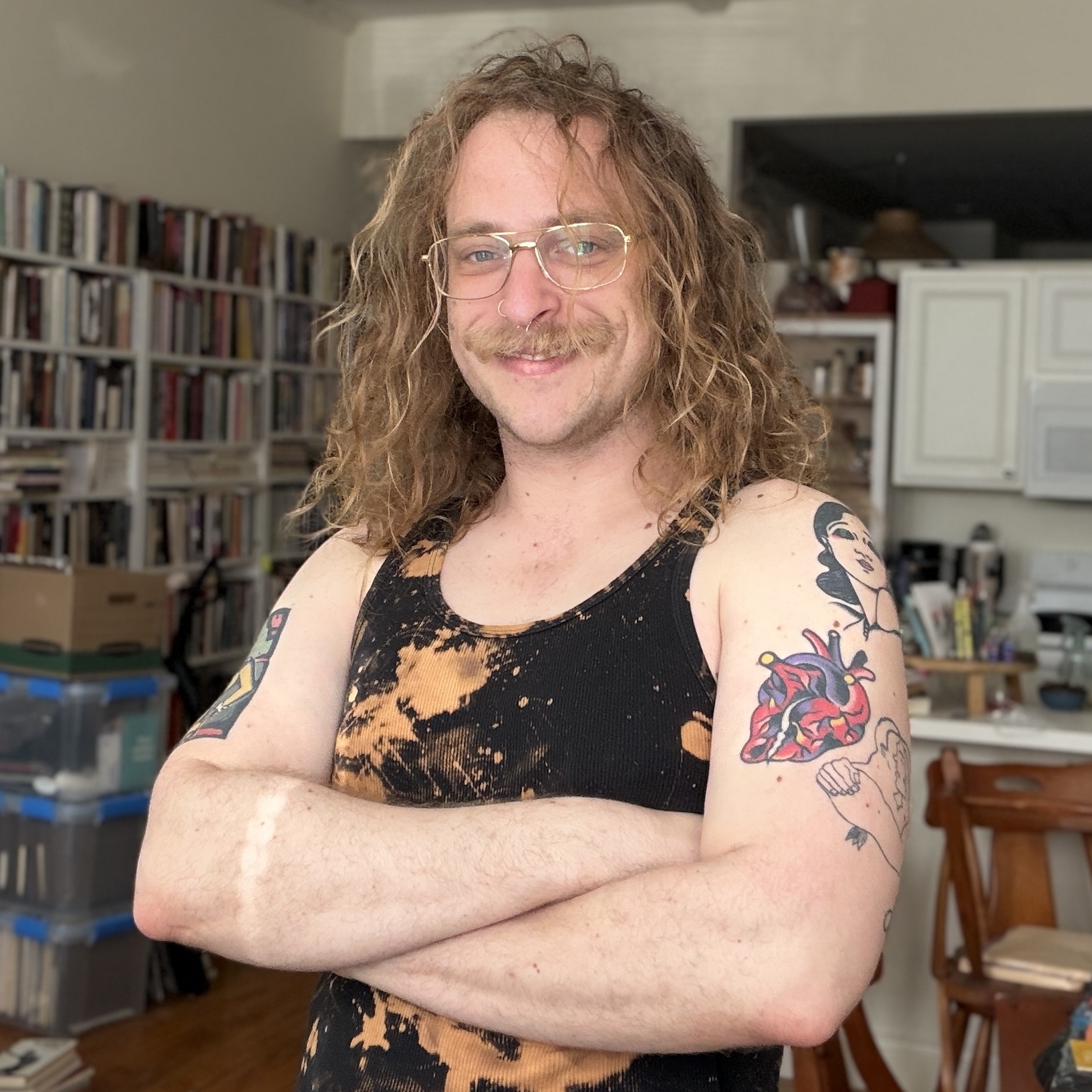
Dr. Samuel Ernest is the founding publisher and editor in chief of Homodoxy, a publishing company for gay/queer/trans theology and literature, the editor of The Rearview and the author of Coarse Work: Essays in Theology and Gay Life. He is co-chair of the Gay Men and Religion Unit at the American Academy of Religion. He received his PhD in religious studies with an emphasis in theology from Yale University in May of this year. Dr. Ernest’s research focuses on the development of gay theology in the United States from the Second Vatican Council through the start of the HIV/AIDS epidemic. He lives in New Haven, CT. More information about him may be found at samuelernest.com.
Recommendations:
Lynne Gerber, Siri Colom, and Arian Nedelman. When We All Get to Heaven. A podcast from Eureka Street Productions, distributed by Slate.
Lynne Gerber. Seeking the Straight and Narrow: Weight Loss and Sexual Reorientation in Evangelical America. University of Chicago Press, 2011.
Lynne Gerber, Mark D. Jordan, and Jim Mitulski. “AIDS, Theology, Liberation: A Panel Discussion with Rev. Jim Mitulski, Mark Jordan, and Lynne Gerber.” March 2, 2017.
Ahmad Greene-Hayes. “Street Evangelists and Transgender Saints: Sylvia Rivera, Marsha P. Johnson, and the Religions of the Afro-Americas.” QTR 1, no. 1 (2024).
Mark D. Jordan. Blessing Same-Sex Unions: The Perils of Queer Romance and the Confusions of Christian Marriage. University of Chicago Press, 2005.
Mark D. Jordan. Queer Callings: Untimely Notes on Names and Desires. Fordham University Press, 2023.
Mark D. Jordan. Recruiting Young Love: How Christians Talk about Homosexuality. University of Chicago Press, 2011.
Wendy Mallette. Lesbian Feminist Killjoys: Sin, Queer Negativity, and Inherited Guilt. New York University Press, 2026.
QTR: A Journal of Trans and Queer Studies in Religion. [All articles are free and online!]
William Stell. Born Again Queer: A History of Evangelical Gay Activism and the Making of American Christianity. Princeton University Press, 2026.
Linn Marie Tonstad. Queer Theology: Beyond Apologetics. Cascade Companions 40. Cascade Books, 2018.
Heather R. White. “Coming Out in the Parish Hall: New York’s Gay Movement and the Church of the Holy Apostles, 1969-70.” QTR: 1, no. 2 (2024).
Heather R. White. Reforming Sodom: Protestants and the Rise of Gay Rights. University of North Carolina Press, 2015.
Unbound Social