
Isaiah 2:1-5; Psalm 122; Romans 13:11-14; Matthew 24:36-44
In the documentary Pay it No Mind: The Life and Times of Marsha P. Johnson, Marsha P. Johnson recounts how her faith is a bedrock of her organizing. At the end of the documentary, Marsha recounts talking to Jesus Christ at a young age about moving to New York City when he says back to her, “You know, you might wind up with nothing.” Marsha retorts back to Jesus, “Honey, I don’t care if I never have nothing ever till the day I die. All I want is my freedom.” As multiple friends and admirers of Marsha P. Johnson can attest, this was how she lived out her life. Marsha could be handed $2 and a bag of cookies, and by the time that she reached the end of the block, she had given all that she had just received away to others who needed it more than her. Agosto Machado, an artist and friend of Marsha, recalls that she was like “Jesus with the loaf of bread and the fish, Marsha always had something to share. Not only her good will and thoughts – a bag of potato chips, she would just hand it to the group of kids.”
Marsha P. Johnson was one of the co-founders of STAR, or Street Transvestite Action Revolutionaries. Her counterpart, Sylvia Rivera, was also a woman of devout faith, and the pair operated a STAR house where they offered transgender youth a place to sleep and food to eat. The STAR house was also a base of organization for STAR’s political project, holding monthly political education meetings, and offering bail, jail and street support to the poor and rejected in their communities.
Marsha and Sylvia and their organizing show us what we need to be doing in this season of waiting. Today, we are endlessly waiting for the worst of what’s to come. The future is horrifying: severe cuts to social spending, war and genocide across the world, an incoming economic crisis, and a descent towards fascism, characterized by the rise of White Christian Nationalism. Our system has crumbled to the point where we know we can’t sit by and wait but instead must prepare ourselves for what’s to come.
I’m sure that there are folks reading this wondering who will be the perfect person that must be coming along to save us. We may have been told to hedge our bets and hopes on the perfect politician who surely will soon be coming out of the woodworks to take a bold and courageous stand. Or we may find ourselves hoping that the Church will finally catch up to the current moment, wielding a power we didn’t realize was there and be able to stop this impending doom in its tracks. We may have even been led astray before by a politician or a pastor who smooth-talked their way into us believing that they really did have the quick and easy answers to what’s ahead of us.
Well, I have some bad news if you came here looking for the quick and easy secret to total social transformation. The only ones who can get us out of this are us, and it’s going to be messy. Marsha, Sylvia, and Jesus all agree.
In today’s Gospel, Jesus urges his followers to be prepared for the coming of the Lord. Much like today, Jesus and his disciples were living and organizing under deeply oppressive, violent, and economically dire conditions, and Jesus and his disciples were building a movement that was young, scrappy, and very broke. Despite being broke, they still managed to undertake massive organizing drives, feeding and healing the most devastated communities across the Roman Empire. Jesus and his movement weren’t waiting for the right ones to come along but these poor and scrappy fishermen realized that if they wanted to be cared for in a sick and wealthy society, they were going to be the ones who had to do it, and they were going to be the ones who had to demand that the system transform to do it too. Like us, his followers could sense that things weren’t getting any better, and so Jesus called on them not to wait passively, but to prepare to fight and struggle for a better world to come.
At the end of this passage, we learn about the nature of the incoming salvation and judgement. What determines what is God and what is not? For this gospel writer and for the early community of Jesus’ followers, God is identified very clearly with the least of these – with the hungry, naked, imprisoned – not with the rich and powerful.
This clarity about God and God’s will is crucial and especially needed in times like these where the truth is so contested. Those in power assert that God is ok with terrorizing our immigrant brothers and sisters and separating families, that peace will come through violence and war, that God wants us to deny the very existence of trans people, and blame the poor and unhoused for their poverty. Some also insist that God is okay if we keep up with business as usual, not examining the ways that we pray or serve our communities despite these times demanding something different.
Advent, though, is the story of something new breaking through; of the new being born; of God revealing Godself anew amidst and through a time of great suffering. This “new” is not announced to, nor is it received by, those with wealth or power, or even the mainstream church. It is a message that is heard by those on the underside of history: the shepherds of the field, by a barren old woman (Elizabeth), a young mother (Mary), and by an old man struck dumb (Zechariah). It is heard by the poor and marginalized, and the way that Jesus will follow this call is both a critique of the cruelty and unholiness of empire, and a reassertion that God is a God of Justice and freedom. (Walter Brueggemann). This freedom, and this refusal of God to be put into a box or a temple is dangerous to those in power because it means the power of God can’t be harnessed, owned, and commodified. God’s love for all creation is unbound, and this threat is why Empire thrashes so violently in the face of the new.
As queer, trans, and nonbinary people, we have incarnated this bigness, beauty beyond control, and freedom of God with our courage to be who we are and honor the same in God. This is a source of hope and leadership in these dark times, and our history shows us this truth.
From underground hormone replacement therapy to drag mothers caring for their daughters, the trans community has had to develop ways to live and care for one another for decades. The need for such projects came out of the realization that no politicians, pastors, or even mainstream gay rights movements were coming to save us. Like Jesus’ movement, the STAR House met the needs of the trans youth in the community while also politicizing these struggles to organize trans youth and their leaders to fight for a system that would care for all. Their manifesto in 1970 signaled their commitment to revolutionary change:
“We want a revolutionary peoples’ government, where transvestites, street people, women, homosexuals, blacks, puerto ricans, indians, and all oppressed people are free, and not f— over by this government who treats us like the scum of the earth and kills us off like flies, one by one, and throws us into jail to rot. This government who spends millions of dollars to go to the moon, and lets the poor Americans starve to death.
POWER TO THE PEOPLE
-S.T.A.R.
STAR, like Jesus’ movement, was also young, scrappy, and very broke. They were raggedy and imperfect, but the boldness in how they organized for the new world shows us what it will take for social transformation: courage to try something new, and a willingness to know that God is on our side, even in the messiness. This Advent season we must prepare ourselves for the fight ahead knowing that we are the ones who will bring about the new world that we are waiting for, and even though it might look messy, it’s what God is calling us to do.
*Language for how individuals have described their gender and sexual identity has and continues to evolve. During the time of the gay liberation movement the term “transgender” was not widely used, and individuals often identified as gay, transvestites, or drag queens. It is widely accepted that leaders such as Marsha P. Johnson – who at the time referred to herself as a transvestite and drag queen – was a transgender woman. Later in her life, Sylvia Rivera would identify both as transgender and as a transvestite. Today, the term “transvestite” is seen as outdated and inappropriate, and “transgender” has replaced this terminology, although whatever term one chooses to identify themself should be used. If you don’t know, it’s always best to ask.

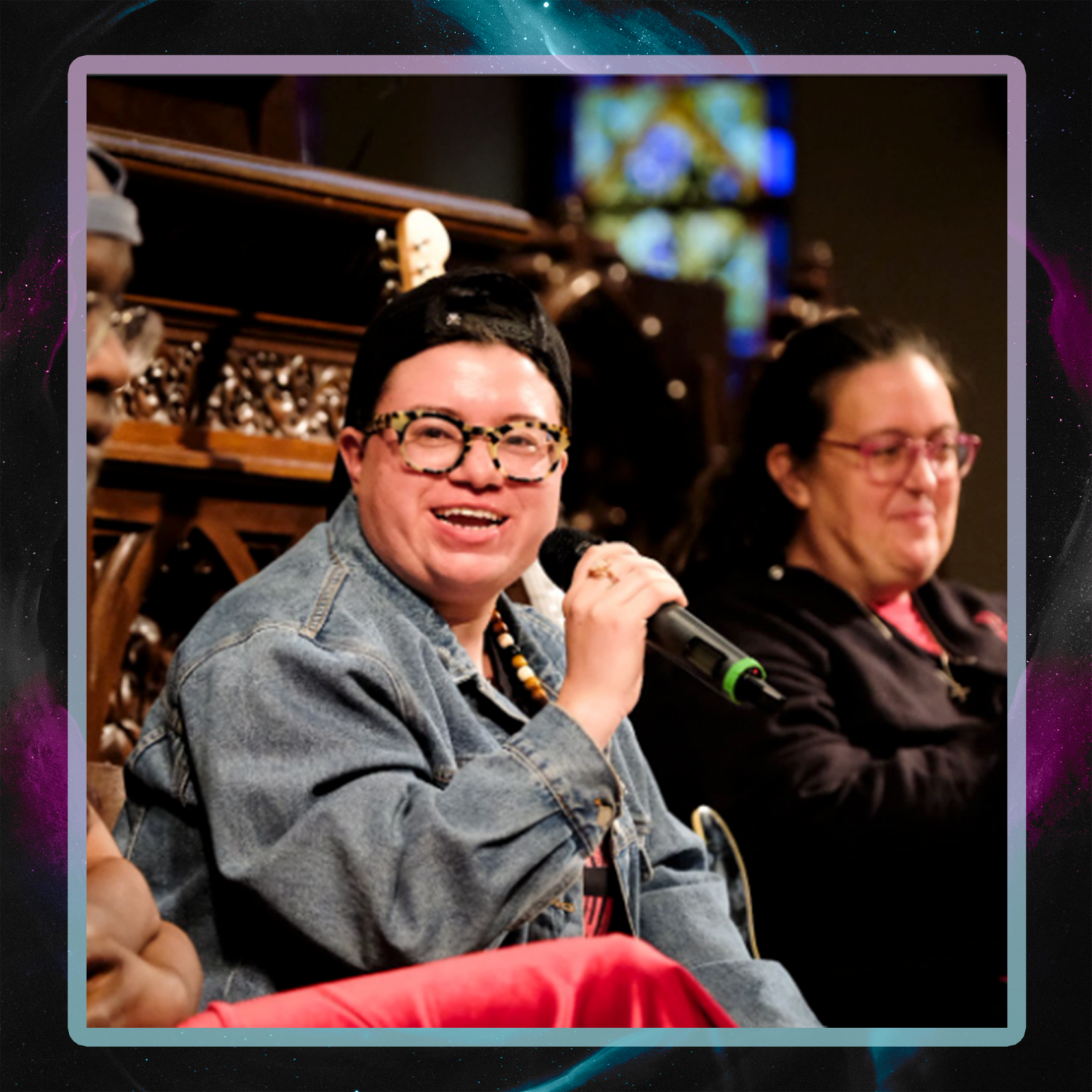
Moses Hernandez McGavin (he/they) is a teacher, cultural worker, organizer, and writer. They have organized Freedom Church of the Poor, the Nonviolent Medicaid Army, the National Union for the Homeless, and with transgender and nonbinary communities across the country. As an educator, Moses has co-developed and co-taught classes on theater, storytelling, culture, and social movements for Emory University and the Sam & Devorah Foundation for Transgender Youth. He served as a Ministry Coordinator with the Church of the Common Ground, helping to facilitate their weekly foot clinic, Bible Study, and community care practices with unhoused folks in Downtown Atlanta. They also served as Community Program Coordinator and Support Group Leader for Transmission Ministry Collective, an online community for transgender and nonbinary Christians. Currently they serve as the Young Organizers Survival Corps Organizer at the Kairos Center for Religions, Rights, and Social Justice.
Apply to join The Young Organizers Survival Corps
Transmission Ministry Collective
Watch the Trans Advent Writer Interview with Moses Hernandez McGavin here.


Unbound Social