

After an infant’s greeting in his mother’s womb, after a maiden’s soul magnifies the Lord, after angels, births, shepherds, more angels, and finally the astonishment of the young Christ’s prodigious intellect in Luke’s first two chapters, Chapter 3 comes as a bit of a slower read. Here, our author takes a step back to fill in some of the details skirted over and begins with an exposition of the call and ministry of John, the baptizer. Baptism becomes a requirement— gift—for everyone as word spreads and people clamor with expectation and excitement at what wonders this sacrament would bring. With both modesty and truth, with an understanding of who he is and isn’t, John is quick to instruct that though his baptism is for a repentance of sin, there is a greater baptism by One who is greater still to come. For this, he is quickly imprisoned. But the One of whom he tells is indeed Jesus, baptized by John and named “the Beloved” as the Holy Spirit descends upon the still-wet Jesus in “bodily form like a dove.” Luke 3 then concludes with a testimony to the beginning of the 33 year-old Jesus’ ministry, while the author details his family lineage all the way back to God’s bosom.
Luke’s genealogy is indeed a very queer thing. In the chronology of gospel writers, we tend to agree that Luke comes third: definitely after Mark, whose text Luke knew, and most likely after—though separately from—Matthew. Luke, like Matthew, follows Mark’s general outline and structure, filling in the details important to their own community that Mark, in his “immediacy” and journalistic haste, may have overlooked. For Matthew, the details needed to fill in the Markan gaps were connections to the Hebrew scriptures and to the fulfillment of Jewish prophesy by a Jewish Messiah sent by a Jewish God to a Jewish people. Matthew’s account is a Jewish writer writing about a Jewish situation, and it connects fully and most directly with the Old Testament promises and prophesies of Yahweh. In practice, the editors of the Bible as we now have it situate Matthew at the start of the New Testament not because it was written first, but because it is the best bridge between the Old and New Testaments vis a vis this Jewish connection. Like Luke, Matthew also includes a genealogy. Unlike Luke, Matthew’s genealogy comes at the very start of the gospel (Matthew 1:1-17), includes five women (Tamar, Rahab, Ruth, Bathsheba, and Mary), and only goes as far back as our father Abraham, who indeed had many sons.
Luke, however, has a different theological project, one that this genealogy illuminates. Matthew’s project is to fulfill Jewish prophesy and announce Jesus as the long-expected Messiah of the Jewish people; Matthew’s gospel does this through a genealogy that is distinctly and entirely Jewish (note that the lineage flows to Abraham, not Abram). Luke, however, is writing to a mixed audience of Jews and Gentiles, circumcised and uncircumcised, ones who follow the Hebrew God’s commandments and ones who knew nothing about them. Here you will note that in addition to baptizing, Luke’s John provides “many other exhortations” (v. 18) and instructions for faithful living (vv. 10-14). The Jewish members of Luke’s audience would have needed no such reminders, but may—like any of us who shoot our hands up when the teacher asks a question we know how to answer—have enjoyed feeling as if they had the inside track on when it came to following The Way. This is not to say Luke’s Gentile audience were the class dunces—they weren’t—but it is to say they held a different sort of power, a normative power, a privilege, and a way that needed to be acknowledged in order to be dismantled and broadened to include those on the margins. Luke’s “good news” is not just a gospel for the Jewish people, but indeed for all people, and the expansion of the beloved community by Luke both welcomes those of us on the outside and problematizes the power system that has kept us where they liked us.
Queer people know a thing or two about this. For many of us, we grew up isolated by our sexual and gender identities in a world distinctly hetero- and cis- normative. For many of us, we were enculturated by power structures, societal norm, and expectations who and how we could love that we would later need to dismantle if we were to truly claim our own inheritance as “beloved” children of God. Here is where Luke is doing something many of us learned first as a defensive structure in the liminal space of perpetually coming out as who we are. Whereas Matthew’s genealogy lists five women—queer in its own sense—to help prove his point, Luke only includes men to help prove his. Luke knew that for his Gentile audience, patriarchy was the norm that first needed to be acknowledged if he truly wanted to change hearts and minds. Yes, this exclusion of women is a patriarchal, male-centered approach; and yes, Luke is writing in a first-century patriarchal, male-centered world. In the words of James Baldwin, “not everything that is faced can be changed, but nothing can be changed until it is faced.”
In Chapter 3’s genealogy, Luke is facing the truth of their world and their world’s view that becomes a necessary counterpoint to the Truth of God made known in the flesh of Jesus, the one known as the Christ. For so many LGBTQ+ people, we come to our identity and our pride by first fully understanding—through our parents, our families of origin, the stories we’re told, the plastic girls in white dresses and plastic boys in tuxedos atop wedding cakes—that which so many get to take for granted, and thus never fully understand. How many of us have said the words “straight people don’t have to come out,” and know that our coming out is a day-by-day practice, never a “one and done” act? How many of us have experienced our own sexual or gender identity expanding day by day, just as the universe expands every day by God’s continual acts of creation and naming each creation “good”? How many of us were so fully versed in ways not of our own, in ways that were not key to our own salvation, ways that would indeed try to deny our salvation, that we learned—somewhere along the way—to first pay at least a little homage to the structures that be in order to find our being?
This is where Luke’s genealogy is at its queerest. What queer people know deep down in our bones—in the knit together places God made while we were still in our mothers’ wombs—is that there are two types of family: origin and chosen. We have biological parents and families of origin where many of us grew up, at least until the point when we couldn’t anymore. Those families have a lineage, a genealogy. Many of us, however, soon enough find that we need to augment those lines—patriarchal and matriarchal—with additional kinfolk that we choose. Along the way, some of us find new older brothers or kid sisters, we find siblings in arms, daddies and mamas, we build new family lines, some of us even do so in new family houses. As we do, we still the story of our births—not just our nativities as infants but the coming out ones as adults, like Jesus, called beloved by God—and our genealogies expand. In telling who we are, we choose who to include. Luke 3 is a similar expansion and genealogy of the original and queerest family of us all. The teller of the tale makes choices about who to include that are different from Matthew’s choices. Luke chooses which family line of Jesus to follow and takes it all the way back to Adam, son of God including both members original and members chosen. Behold, the young maiden will bear the child of God who has two dads: God the Father and Joseph the Carpenter. Thanks be to God.

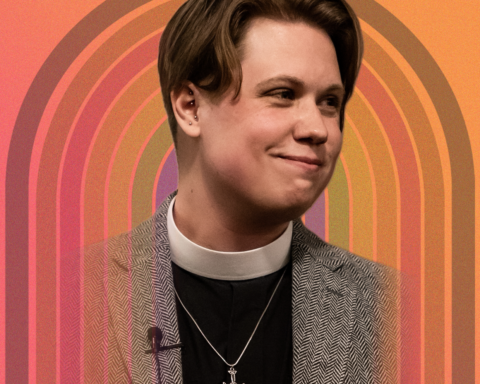
The Rev. William Critzman serves as President of the Collegiate Church of New York and Senior Minster of West End Church on Manhattan’s Upper West Side. He is the first openly queer person to serve this oldest continually worshipping church in America. Will has been named an ABC News “Pride Champion for Change” and his work in the intersection of faith, LGBTQ+ wellness, and art is detailed in the feature length documentary Sanctuary. You can read more about Will and the ministry of West End Church at westendchurch.org.

Unbound Social