

The resurrection is a trans woman.
It’s easy to miss that part, since the events of Luke’s 24th chapter all take place during a single day. In one day, Jesus goes missing from her tomb, schools two disciples on the road (they don’t recognize her until she breaks bread with them in Emmaus), zaps back to Jerusalem to appear to the whole assembled group of disciples where they get to poke at her scars in exchange for snacks, opens their minds to understand the Scriptures, takes the team out to Bethany, and disappears into the heavens with a promise that power will come to them soon. Jesus’ resurrected life happens bewilderingly fast.
But let us not dwell on the fact of the resurrection so much so that we miss the way it comes. I want you to seriously, faithfully consider with me that Jesus resurrects in a woman’s body – not some metaphorical feminizing of the spirit, I mean a literal bodily transformation. And specifically to a woman because if we we cannot imagine her coming to us in the form of a woman, which is already quite queer, we have no hope of imagining her coming in the shape of something even queerer.
And before you decry the dangers of me reading something into the text that isn’t there, really think about it: if Jesus had resurrected into a woman’s body … would we have heard about it?
Would the women at the tomb have preached that part to us? Maybe. But in Luke the women don’t see her alive at the tomb. Only the clothes associated with her gender assigned at incarnation remain there to show us who used to be in the tomb. We do not get told what she is wearing after this. Perhaps the new outfit, like her new flesh, better aligns with her gender at begetting?
It’s only as “companions of the eleven” later that day, elsewhere in the city, that the women encounter Jesus in the flesh, and at that point the narrative has men at the center of the camera, and the men are dumbstruck. If the group of disciples did remark about Jesus being a woman, would the evangelists have told us about their discussion? I’m doubtful. I look at the obituaries of murdered trans women from this month and find it hard to believe that Jesus could have escaped being mis-pronouned and having this big deal part of her identity edited out.
Even if the evangelists’ accounts had kept that detail, would the scandal of that body’s new shape really have been documented? Or would it have been edited out by well-meaning first century retellers, as so often happened with similarly uncomfortable details? Perhaps struck for the Good Of The Movement? Was it interfering with how converts were receiving the good news? After all, the important message of life after death shouldn’t be eclipsed by a mere footnote like the secondary sex characteristics of the body that life was wearing … right? Too much is at stake for the whole truth to be told.
Jesus resurrecting in a woman’s body would make a lot of the story make sense. For one thing, people have a hard time recognizing Jesus post-resurrection, both in Luke’s and John’s accounts. But the body is connected enough to her former form that when the person of Jesus shines through to Cleopas and his friend, or to Mary Magdalene in John, recognition follows. The body may have been altered by the miracle version of hormone replacement therapy, but only enough to reveal its femaleness. There’s still something about the smile. The mannerisms. The way she breaks bread.
The narrator uses the name “Jesus” when telling Luke’s post-resurrection story, but none of the disciples do (men, women or otherwise), neither when speaking to nor when talking about her. They exclusively use a title – “the Lord”, masculine by default except when you consider that the many-and-no-gendered God is referred to with the same title. Does Jesus now have another name she wants her friends to use? Are they still in the awkward transition period of trying not to use her deadname but the new name still being too unfamiliar in the mouth?
If Jesus really had resurrected in a woman’s body wouldn’t our record of it look exactly like this?
Okay, so … so what? So what if it could be that Jesus came back in a woman’s body. Why does that matter? What does a Christian gain from exploring this possibility?
The Church – that collective Christian – is privileged, cursed, destined, doomed, and freed to participate in the story of Jesus specifically as the Body of Christ. Which means if we want to know the next chapter in the life of today’s Body, we must study that story carefully. Study what is said, what is not said, and what is lurking between the lines. Whatever happens to Christ’s body in the gospel has happened, is happening, or will happen to the Body of Christ in the world.
This has a number of implications. For one thing, if we lay upon the Church similar expectations to those the disciples laid onto Jesus – of sticking to the labels we assigned to her at her birth – we risk failing to recognize Church after her resurrection.
But more than that, according to Luke’s narrative, Church, like Jesus, may very well have already died, been buried, and been resurrected without coming to tell us about it herself. The ones in the know are gender nonconforming angels and women preachers, and most of us aren’t in the habit of listening to either. Church may be alive again while we’re still arguing with one another about how best to keep her on life support in hospice.
If we want to find Church alive in her resurrection, we must look to the gospel for the ways the resurrected Jesus appeared to the disciples to learn how Church must certainly already be appearing to us. And we must consider that she is appearing as a trans woman appears:
If the resurrection is a trans woman, then the new Body of Christ has women as its face. It is centering women, is woman-led, concerns itself with the affairs of women, and is protecting women from harm by standing with them as one of them. What movement is doing those things now?
If the resurrection is a trans woman, then the new Body of Christ has the audacity to not just live but thrive, unconstrained by our expectations of place or status. She is out and on the move – not entombed in centers of concentrated religious power, but doing Bible study with random nerds she meets on the street. Where are these impermanent places that people are gathering? Could I meet her on my local dirt road?
If the resurrection is a trans woman, then the new Body of Christ, the new container for ritual to facilitate connection to the Divine, does not have the old shape that we remember her having. What shape does she have now?
If the resurrection is a trans woman, then the new Body of Christ will be using a new name. She won’t be calling herself “Church” anymore, and no one who loves her in her resurrected state will be either. What does she call herself now?
If the resurrection is a trans woman, then the new Body of Christ has given up any privilege she used to receive from her performance of masculinity and is instead identifying publicly and visibly with womanly things. Things soft and gentle and pretty. And certainly not above stretching “womanly” to include loving things fierce, or enduring, or strong. Where are these traits being celebrated? Where are binaries breaking?
If the resurrection is a trans woman, then the new Body of Christ still has wounds from the violence we have done to her and from the pain of being anything other than her authentic self. She is not hiding these wounds but flaunts them. Where are they on display? How is she inviting her followers to poke at them?
The Good News Luke has for us is that abandoned tomb. The reign of God is busy already and didn’t wait for us to get started. Let us stop wringing our hands about the impending death of Church and go and seek her.
She is risen. She is not here.

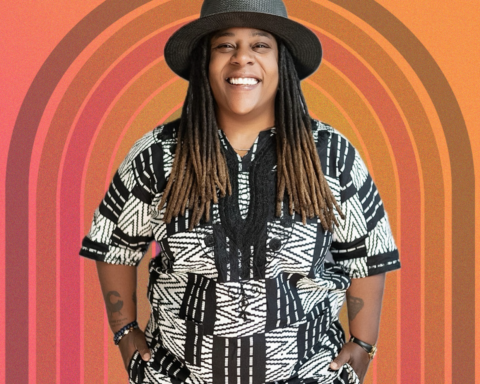
Mx. Kate Davoli (they/them) has the honor of being first person to have been dismissed from the ordination process of the Presbyterian Church USA for being openly polyamorous. Their Call remains, however, and Kate ministers to queer and ex-vangelical individuals and communities as a Ruling Elder, a lay preacher, a spiritual director, and a teacher of vocational discernment. They earned their Master of Divinity degree from Pittsburgh Theological Seminary, and currently they serve on the boards of directors of More Light Presbyterians, Juniper Formation’s Daily Ripple Ministry, and the ecumenical collaborative LAMP: the LGBTQIA+ Affirming Ministries of Pittsburgh. The Discernment Compass process Kate created informs the decision-making of faith-based organizations nationwide and they are the author of two books on deciding things together: The Chairperson’s Toolbox and Group Discernment Bootcamp.



Unbound Social