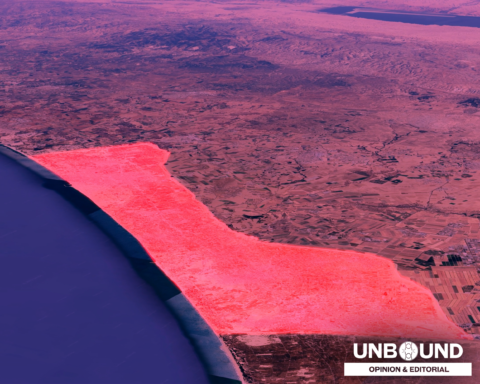



Earlier this year, a Gaza-bound flotilla carrying humanitarian aid, symbolizing the shared struggle to provide resources to Palestinians was recently intercepted by Israeli naval forces. Much international outrage has been directed at Israel’s treatment of the detainees, especially after Itamar Ben-Gvir, Israel’s far-right Minister of National Security, was seen taunting detained activists and journalists. With the death toll in Gaza exceeding 75,000, including almost 23,000 children killed by “direct actions” between October 7, 2023, and January 5, 2025, and with continued Israeli airstrikes killing Palestinians in “humanitarian zones,” the growing chorus of awareness and resistance to Israeli actions in Gaza continues to intensify.
But these issues do not remain confined to the immediate geopolitical theaters of the Middle East. They extend outward into our own communities and neighborhoods. For example, in 2025, even as some crimes against Jews, such as vandalism and arson, have reportedly declined overall, violent antisemitic crimes have increased. In the U.K., antisemitism has also risen, causing alarm among Jewish communities, especially as some have linked hostility toward Jews to perceptions of Israel’s actions in Gaza and the recent war with Iran. Thus, the actions of the U.S. and Israel toward their neighbors and foes can have unintended consequences far beyond the region itself, including in places like the U.K. and the U.S., showing that these issues are global in scope and affect us all.
But these issues do not remain confined to the immediate geopolitical theaters of the Middle East. They extend outward into our own communities and neighborhoods.
In debates over Israel and Palestine, Christians often speak as if they must choose between Jewish safety and Palestinian freedom. One side rightly cites the long history of antisemitism, the trauma of October 7, and the fears many Jewish communities carry in a world where Jewish identity is again treated with suspicion. The other side appropriately names the suffering of Palestinians under occupation, displacement, and political abandonment. But as the Rev. Dr. Mae Elise Cannon articulates, writing for Unbound, “The elimination of Palestinian people from their historic homeland is not inevitable.” She continues, urging safety for all peoples, including Jews and Israelis until the violence ends. The destiny of both Palestinians and Israelis are inextricably connected.
In debates over Israel and Palestine, Christians often speak as if they must choose between Jewish safety and Palestinian freedom.
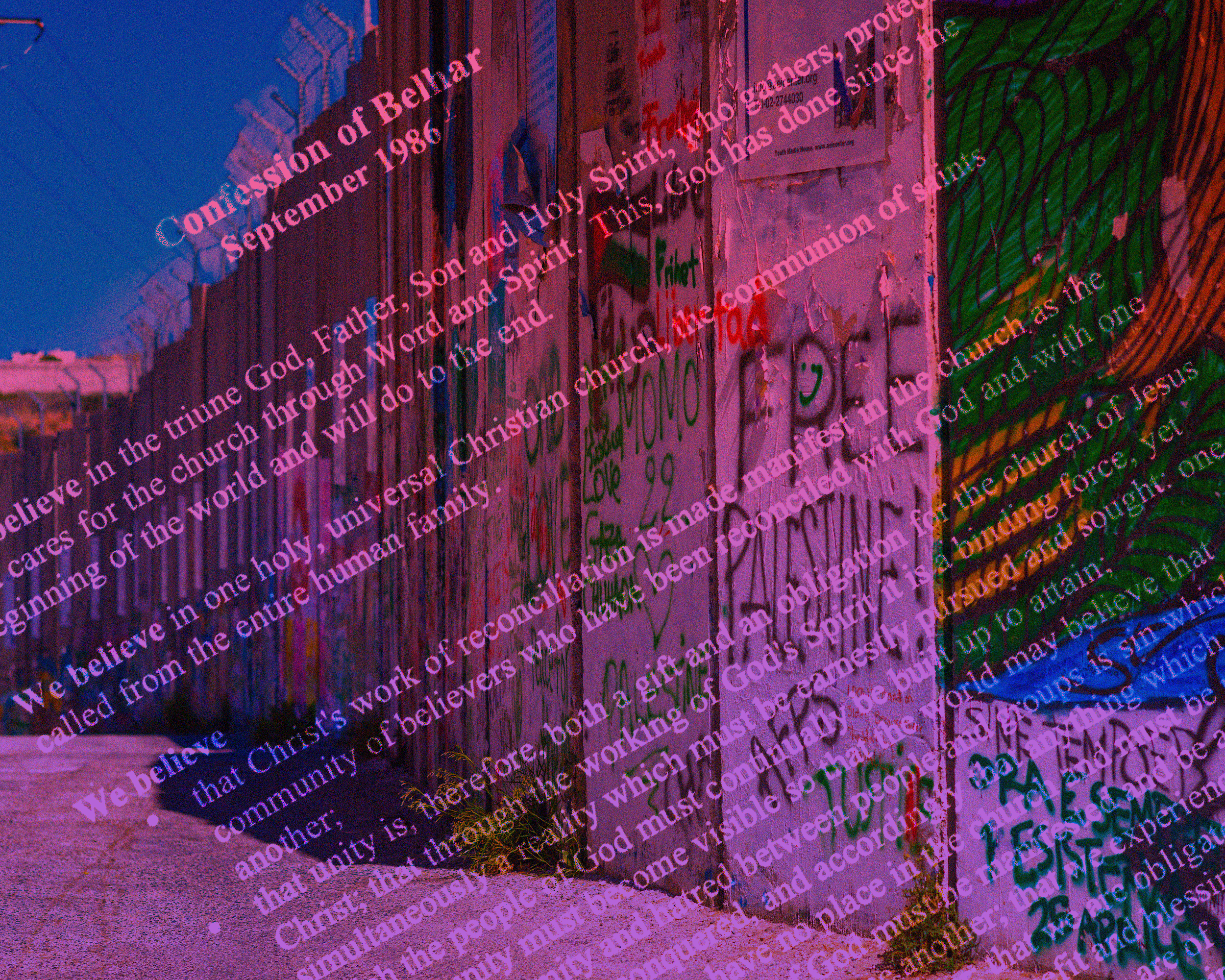
The Belhar Confession, first drafted in 1982, is a modern Reformed confession that emerged from the struggle of South African churches against apartheid. It was formally adopted by the Dutch Reformed Mission Church (DRMC), which later became part of the Uniting Reformed Church in Southern Africa (URCSA). This contrasts with the white Dutch Reformed Church (NGK), which has not adopted the confession. In 2010, the Reformed Church in America (RCA) officially adopted Belhar as its fourth confession, while the Christian Reformed Church in North America (CRCNA) adopted it as a “contemporary testimony,” encouraging the incorporation of its themes into discipleship and liturgical structures.
Belhar emphasizes three major themes. The first is unity, grounded in the recognition that we are one body in Christ (1 Cor. 12:12–13). This unity binds us together in a shared commitment to Christ and to one another. It also means that theological resources utilized in one struggle can be shared with those facing other struggles, as seen, for example, in the connection between Korean Minjung theology and Israel-Palestine. Unity recognizes that injustice in one part of the world affects us all, especially as Christians who are called to remember the suffering of brothers and sisters in Christ in the Occupied Territories.
Belhar also emphasizes reconciliation. Christians are reconciled to God through Christ and entrusted with a ministry of reconciliation (2 Cor. 5:18–19). In South Africa, one of the ways reconciliation was pursued was through the Truth and Reconciliation Commission (TRC). The TRC sought to address the wounds and consequences of apartheid through restorative means. Victims were invited to share their stories, while perpetrators could request amnesty if they fully disclosed their crimes. One of the major threads of the TRC was the recognition that truth must precede true reconciliation. In that same spirit, Desmond Tutu forcefully argued in a 2012 interview that, in many respects, the conditions faced by Palestinians were worse than those endured by Black South Africans under apartheid. Before we can seek reconciliation in the region, we must recognize the material conditions of those suffering.
Before we can seek reconciliation in the region, we must recognize the material conditions of those suffering.
The final major theme in Belhar is justice. One article in the confession states that the church must stand with people against every form of suffering and must witness against injustice. As Christians, we hope for true righteousness to permeate our lands and communities, where injustice is addressed and justice can “roll down like waters, and righteousness like an ever-flowing stream” (Amos 5:24). Taken in the prophetic spirit of Amos, the prophet’s international vision of God’s judgment against war crimes and humanitarian abuses maps well onto Israel and Palestine today. As I argue in another piece for Baptist News Global, “Much of Western Christian theology can drift toward abstraction, and we often default to the individual’s need for salvation, with less attention to the social and political dimensions of sin that the prophets refuse to ignore.”
Ultimately, Belhar insists that unity, reconciliation, and justice belong together, rejecting any theology that blesses enforced separation or calls injustice “peace.”
Ultimately, Belhar insists that unity, reconciliation, and justice belong together, rejecting any theology that blesses enforced separation or calls injustice “peace.” Applied to Israel and Palestine, Belhar does not permit Christians to erase Jewish vulnerability or reduce Jewish identity to the actions of the Israeli state. But neither does it allow Christians to treat Jewish safety as something that can be secured through Palestinian insecurity. Belhar helps Christians speak with moral clarity in a polarized moment like our own. Antisemitism must be rejected without qualification, and Palestinian life and dignity must be protected. Whether we are naming Israeli actions in Gaza as catastrophic and calling them out or drawing attention to growing antisemitism in cities across the U.S. and U.K., the center of our struggle must be the gospel, which steers us away from partisan loyalty and toward justice, reconciliation, and peace.
Rubin James Yi McClain is an Ambassador Warren Clark Fellow with Churches for Middle East Peace and recently completed a Ph.D. in New Testament at the University of Glasgow. His work explores how multiethnic identities were negotiated and utilized as fluid concepts in the ancient world, and how these dynamics continue to shape Christian theology and discourse today. He also writes about peacebuilding in the Middle East, with particular attention to Israel and Palestine.
Beyond his writing, Rubin is deeply committed to ecumenical engagement. He regularly organizes outings to visit and learn from different liturgical traditions, cultivating dialogue and appreciation for the diverse and vibrant expressions of the Christian faith.