
Good Christian Folks, Like Us
November 18, 2011, by Patrick David Heery, an editorial They Have Names
Shelley Hilliard was 19 years old when she was murdered on October 23, 2011 in Detroit, Michigan. Her mother had to identify what was left of her burnt body at the medical examiner’s office. Shelley had been born “Henry,” and was a transgender woman.[1]
Gaurav Gopalan was 35 years old when he was murdered on September 10, 2011 in Washington, D.C. The medical examiner attributed his death to hemorrhaging in the brain due to blunt impact trauma. The same week that Gaurav was assaulted and killed, several other transgender individuals were violently attacked in the D.C. area.[2]
Camila Guzman was 38 years old when she was murdered on August 1, 2011 in New York City. She was stabbed repeatedly. The news article that reported her murder introduced her as a “transgender hooker” and insisted on using only masculine pronouns and her given name of “Rodrigo.” The article never used her chosen—her real—name.[3]
___________________________________________
Every day, good, Christians folks just like us render the transgender person invisible,
disqualified from our society, our schools, and our churches,
exposing that person to attack and exploitation…
___________________________________________
Jessica Rollon, strangled, 32 years old. Ramazan Cetin, shot to death by her brother while lying in a hospital bed, 24 years old. Lashai Mclean, shot, 23 years old. Tyra Trent, strangled, 25 years old. Krissy Bates, stabbed, 45 years old. Marcal Camero Tye, shot and dragged, 25 years old.
These are just some of the names of the people assaulted and killed in the year 2011—killed for no other reason than the fact that they deviated from prescribed gender norms. Gaurav wore makeup. Ramazan “dishonored” her brother. Shelley identified as a woman. And for this, they were brutally maimed and killed.
National Transgender Day of Remembrance
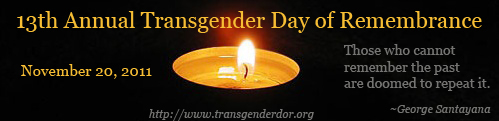
November 20, 2011—this Sunday—is the national Transgender Day of Remembrance: “an opportunity for communities to come together and mark the passing of transgender or those perceived to be transgender individuals who have been murdered because of hate.”[4] (If you are not familiar with the term “transgender,” you can find a summary of its meanings at the end of this article.)
Recount these stories, and many will gasp at the tragedy of it all and quickly condemn the actions of these crazed murderers. Fortunately, these killers comprise a tiny, delinquent minority. Fortunately, we are not like that.
Or are we?
Every day, good, Christian parents kick out their transgender children, so that they have to live on the streets, hungry and vulnerable to sexual exploitation. Churches all across America rarely, if ever, acknowledge the transgender people just beyond their walls—or in their pews. Newspapers and online media subtly justify murder with labels like “hooker” and “prostitute.” Like countless families, such editors often resist using the name and pronouns with which the transgender person identifies, as if that person did not truly exist. Insurance companies deny medical treatment; doctors often do not have adequate training. Legislators add the provision that anti-bullying legislation does not apply when religious and moral beliefs, such as rejection of transgender identity, are involved.
___________________________________________
If there is anyone in that passage with whom Christ is identified, it is, I contend,
the one deemed gender-deviant, the Ethiopian.
___________________________________________
Every day, good, Christians folks just like us render the transgender person invisible, disqualified from our society, our schools, and our churches, exposing that person to attack and exploitation because, frankly, who cares about someone you cannot see?[5]
We may not have murdered the individuals named above, but have no illusion: we made their murders possible.
Some Old Fashioned Baptism
There is a passage in Isaiah that reads, “In his humiliation, justice was denied him. Who can describe his generation? For his life is taken away from the earth.” That passage shows up again in the Book of Acts 8:26-40.
Shortly after preaching in Samaria (a country full of the “unclean”), Philip meets an Ethiopian eunuch, who is neither “man” as conventionally defined in Hebrew thought, nor “woman.” He occupies that uncomfortable, ambiguous space in between gender construction.[6] He may speak with an “effeminate” voice. He probably is much darker in skin color than Philip. In other words, here in Acts, we have the Other: a foreign and “alien” man of color who transgresses gender boundaries, met on what the text calls a “wilderness road.” He is reading in the Book of Isaiah about humiliation and injustice. Then he hears about Jesus, another person humiliated and assaulted, another person deemed “other” such that he had to be killed. Suddenly, he says, “Look! Here is water! What is to prevent me from being baptized?” And so, right there, he is baptized.
“What is to prevent me from being baptized?” he asks. It is a question met with no answer. Because, there is no answer. There is nothing to prevent his baptism. Not his gender or sexual identity. Not the color of his skin. Not the fact that he is from a foreign country. Nor does he need to change any of this to be baptized. He does not need to repent of being Ethiopian or a eunuch. He is baptized “as is.”
Maybe we should ask a similar question.[7] What is to prevent us from loving and respecting the transgender person? Why, nothing at all. Certainly not the condition, “I’ll love you when you change.”
And so maybe, this time, it is we who need some good, old fashioned baptism: we who need to be cleansed of our sins of exclusion and gender-normativity, our rejection of our brothers and sisters in Christ. Maybe this time, the transgender person will baptize us and it is we who will be saved, because if there is anyone in that passage with whom Christ is identified, it is, I contend, the one deemed gender-deviant, the Ethiopian.
Postscript… I hope that this short article will be a rallying cry and will generate conversation that explores the many questions and issues (of justice, theology, biblical interpretation, queer and psycho-social theories, and the many complexities of transgender identities) not treated here comprehensively.
_____________________________________________________
Your Toolkit for Transgender Day of Remembrance
Transgender: The term can be a broadly encompassing category including anyone who “transgresses” socially-determined gender boundaries, such as transsexuals, cross-dressers, people identifying as queer, and individuals who identify as neither male nor female. More specifically, the term often refers to people “whose psychological self (‘gender identity’) differs from the social expectations for the physical sex they were born with.” The term pertains to gender, not sexual orientation. Please note that just because someone may meet the criteria of transgender identity, that individual may not identify as transgender. It is always best to allow the individual to identify him- or herself.[8]
Take action:
- Check here to see if there is a registered vigil in your area.
- Cannot find a vigil in your area? Organize your own! Get some candles, some people, and the names of those who have been killed. Here are resources for your vigil, including poetry, music, and tips (note that the statistical information is outdated).
- Reach out to someone isolated in your family, church, school, or community. What they need most is probably just someone to listen and care.
- Become an ally. Tell your friends and family. Take the pledge today!
- Students, learn how to make your club/school/community transgender inclusive through this easy-to-follow guide.
- Write your lawmakers to demand a fully inclusive Employment Non-Discrimination Act.
Learn more:
- Click here to learn more about the national Transgender Day of Remembrance.
- Read Injustice at Every Turn: A Report of the National Transgender Discrimination Survey.
- Read “Our Spirits, Ourselves,” a brief and moving witness on the More Light Presbyterians site, written by Alex Patchin McNeill, an inquirer for ministry, who identifies as transgender.
- Kicked Out edited by Sassafras Lowrey (Ypsilanti, Michigan: Homofactus Press, 2010) is a great read if you want to know more about LGBTQQI youth homelessness, offering first hand accounts, statistics, and ideas for change.
- HRC’s Transgender Visibility Guide is a resource for individuals coming out and for their families and friends.
- This site can help you find out which insurance companies will assist with medical procedures and healthcare, and which will not. Check out HRC’s Task Force to Address Insurance Industry Practices.
[1] All names of victims derive from the International Transgender Day of Remembrance memorial website: http://www.transgenderdor.org/?page_id=1663.
[2] John Riley, “Gopalan Death Ruled Homicide,” MetroWeekly, Sept 20, 2011: http://metroweekly.com/news/?ak=6584.
[3]Doug Auer, “New Device Helps ID Murdered Transgender Hooker,” New York Post, Aug 3, 2011: http://www.nypost.com/p/news/local/manhattan/new_device_helps_id_murdered_transgender_5dgiYYMtsmcZTgBmbREpmL#ixzz1U9843Dpy.
[4] Human Rights Campaign, http://www.hrc.org/campaigns/transgender-day-of-remembrance.
[5] My colleague and senior editor, Chris Iosso, adds, “And for many of us not consciously driven by hate or fear, transgender individuals raise difficult questions about the psychology of sexual identification, the age for surgical and chemical intervention, and the nature of embodiment and attraction. Certainly most denominations have not addressed these challenging issues, even if growing numbers of counselors and doctors have.”
[6] Of course, there are many Christians who would resist the definition of gender as social construction, perhaps alluding to the Genesis account of the creation of man and woman as not only a definer of biological sex but also gender roles/identities. However, the Bible is also full of gender re-constructions, including the establishment of patriarchal laws; the decision to grant land inheritance rights to the daughters of Zelophehad (Numbers 27); and the use of both “feminine” and “masculine” descriptions of Jesus. When a concept does not directly appear in scripture, we carefully examine scripture to see what principles can be extracted to assist in new matters such as these. In this case, we might look to the ultimate commandment of love, Jesus’ identification with the other and the oppressed (Matthew 25), the prescription “neither male, nor female,” and the gender-role reversals that occur throughout the Bible, particularly the New Testament, while honestly wrestling with the texts that reinforce gender binaries.
[7] Admittedly, there are limits to this analogy. The modern or post-modern concepts of gender and transgender did not exist in biblical times. Additionally, it is not clear from the text whether the Ethiopian’s castration was a choice (men not destined to inherit their families’ wealth occasionally chose eunuch-status as entry into public, royal life) or an instance of coercion and oppression. The Isaiah text would imply the latter, whereas for many transgender persons, their identity is a source of liberation and happiness. Yet, our reactions to the “other” may well resemble our ancestors’ reactions to those they felt were “unclean.”
[8] “Transgender,” Gender Equity Resource Center, UC Berkeley, http://geneq.berkeley.edu/lgbt_resources_definiton_of_terms#transgender.
Unbound Social